Omni-Channel Healthcare CRM Best Practices

As Customer Relationship Management (CRM) has evolved over the years, it has expanded its reach to a broader ecosystem of tightly integrated capabilities, applications, and functions. One of the primary reasons for the expansion is the need for the CRM strategy to be Omni-Channel which requires it to be multi-channel, multi-stakeholder and be context aware of all channel interactions. Here are the key capabilities of the modern Omni-Channel CRM ecosystem:
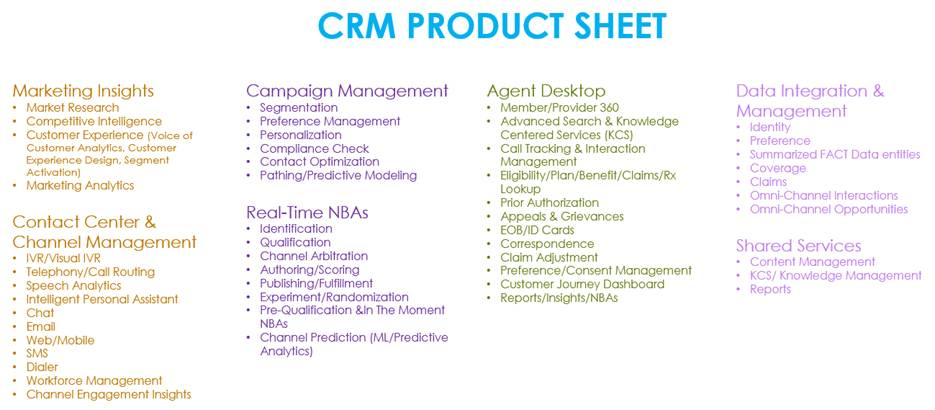
1. Marketing Insights – As we all know, CRM is a critical component of any Marketing Strategy and the key Marketing components that enable CRM are Market Research, Competitive Intelligence, Customer Experience (Voice of Customer Analytics, Customer Experience Design, Segment Activation) and Marketing Analytics (CDP - Customer Data Platform, DMP – Data Management Platform).
2. Contact Center & Channel Management – For a robust CRM Strategy, we need to enable all channels and ensure they are optimally utilized. The key components for this capability include IVR/Visual IVR, Telephony/Call Routing, Speech Analytics, Intelligent Personal Assistant, Chat, Email, Web/Mobile, SMS, Dialer, Workforce Management and Channel Engagement Insights
3. Campaign Management – For any CRM implementation, we need a robust Campaign Management platform that enables Customer Segmentation, Preference Management, Personalization, Compliance check, Contact Optimization and Pathing/Predictive Modeling.
4. Real-time Next Best Actions (NBA) – Another critical capability that needs to be enabled in a CRM implementation is creating Real-time NBAs that are relevant and timely for customers to take actions and realize better healthcare outcomes. Key components involved in successfully enabling NBAs include NBA Identification, Qualification, Channel Arbitration, Authoring/Scoring, Publishing/Fulfillment, Experiment/Randomization, Pre-Qualification & In the Moment NBAs, Channel Prediction (ML/Predictive Analytics).
5. Agent Desktop – It is crucial to have our Customer Service Agents be integrated into the CRM Strategy and be able to support our customers with relevant data that answers their inquiries and also advises them on the right insights and call to actions enabling better healthcare outcomes. Key components needed for a mature Agent Desktop include Customer/Provider 360, Advanced Search & Knowledge Centered Services (KCS), Call Tracking & Interaction Management, Eligibility/Plan/Benefit/Claims/Rx Lookup, Prior Authorization, Appeals & Grievances, EOB/ID Cards, Correspondence, Claim Adjustment, Preference/Consent Management, Customer Journey Dashboard and Reports/Insights/NBAs.
6. Data Integration & Management – No CRM Strategy will be complete w/o appropriate data integration with all the source systems that store & maintain relevant data sets. Key data entities that are crucial to a CRM Strategy include Identity, Preference, Summarized FACT Data entities, Coverage, Claims, Omni-Channel Interactions and Omni-Channel Opportunities.
7. Shared Services – Finally, we need a few critical shared services that support CRM Strategy along with other strategies including Digital. These include Content Management, KCS based Knowledge Management and Reporting.
Here is a quick reference Product Sheet for the capabilities & components reviewed above.
Summary & Implementation Notes – In Summary, CRM Strategy is no longer a strategy that is limited to some stakeholders and channels. It has expanded and merged with various strategies and functions including Contact Center, Service Operations and Digital. As a result, we no longer can perform all these functions through a single suite of vendor products. Instead, it is an ecosystem of enterprise applications that are inter-dependent and are expected to tightly integrate with each other through open source-based technologies and frameworks.