Provider Digitization Strategy & Experience

As the Payer-Provider relationship has evolved over the years, it has become apparent that they need to collaborate more than ever and trust each other to exchange relevant data between them that will result in a better healthcare outcome for our customers. This will be very crucial to reduce the overall healthcare cost that is currently ‘out of control’ and improve the overall quality of care which is way behind compared to other developed countries. While technology investment in healthcare has been a focus for the past decade in the US, the outcome has not been satisfactory and proportional to the overall investment and cost of care. This warrants us to get into high gear and look for more ways to further improve the outcome. One of ways to do that from a Payer perspective is to focus on Provider Digitization for all its interaction with the Providers. To do that following are the key Capabilities and Experiences that a Payer needs to focus on as part of its Provider Digitalization Strategy.
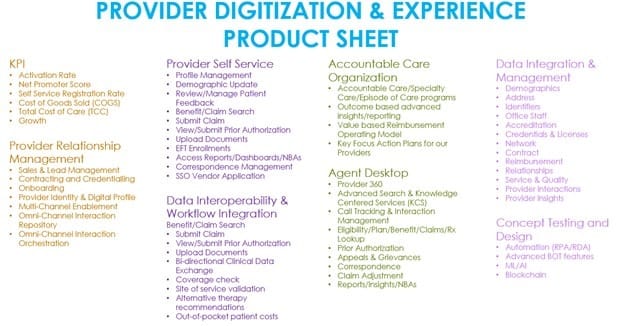
1. Establish KPIs – Fundamental to a Provider Digitization Strategy is establishing a set of KPIs that is adopted by all stakeholders and tracked regularly to adjust the strategy and initiatives supporting the strategy. The most widely accepted KPIs include Activation Rate, Net Promoter Score, Self Service Registration Rate, Cost of Goods Sold (COGS), Total Cost of Care (TCC) and Growth.
2. Provider Relationship Management – This is an important Experience that enables successful lead generation, acquisition, onboarding, and interaction management of a Provider. The key components of this Experience are Sales & Lead Management, Contracting and Credentialling, Onboarding, Provider Identity & Digital Profile, Multi-Channel Enablement, Omni-Channel Interaction Repository, Omni-Channel Interaction Orchestration (NBAs etc.)
3. Provider Self Service – Ultimately this Experience should be the focus to enable all transactional interactions and engagements with a Provider. While a Provider has the challenge of dealing with multiple Payers and would prefer all Payer interactions to be integrated into their workflow, having a Digital brand associated with a Payer is crucial to a successful relationship with Provider. Also enabling as many of the functions thru self-service will enable faster resolution to any inquiries and be most cost effective. Key components of this experience include Profile & Preference Management, Demographic Updates, Review/Manage Patient Feedback, Benefit/Claim Search, Submit Claim, View/Submit Prior Authorization, Upload Documents, EFT Enrollments, Access Reports/Dashboards/NBAs, Correspondence Management and Single Sign On to an already existing vendor application.
4. Data Interoperability & Workflow Integration – Unlike Payer interaction with Customers where Payers typically have exclusive access to their customers, Providers need to interact with multiple Payers which necessitates a preference for Providers to have Payers integrate into their workflow. Key components that Providers would like to be integrated into their workflow include Benefit/Claim Search, Submit Claim, View/Submit Prior Authorization, Upload Documents , Bi-directional Clinical Data Exchange, Coverage check, Site of service validation, Alternative therapy recommendations and Out-of-pocket patient costs. This Experience should enable any of the components referred above thru industry standard formats including EDI and HL7/FHIR where applicable. Note that some of these components will be redundant with Self Service Experience (#3 above) as we will need to support Provider choice to leverage appropriate Experience that suits their needs.
5. Accountable Care Organization - With a heavy focus on shifting to value based care arrangements with our providers, we need to have a separate Experience to manage the capabilities that enable high performing providers to be provider affordable and highest quality of care to our customers. Key components include Accountable Care/Specialty Care/Episode of Care programs, Outcome based advanced insights/reporting, Value based Reimbursement Operating Model and Key Focus Action Plans for our Providers.
6. Agent Desktop – While we continue to focus on Self Service Experience, we need to ensure we have a robust Experience that caters for Provider inquiries and tasks that are not contained thru the Self-Service channels. It is crucial to have our Provider Service Agents be integrated into the Provider Digital Strategy and be able to support our providers with relevant data that answers their inquiries and also advises them on the right insights and call to actions enabling better healthcare outcomes. Key components needed for a mature Agent Desktop include Provider 360, Advanced Search & Knowledge Centered Services (KCS), Call Tracking & Interaction Management, Eligibility/Plan/Benefit/Claims/Rx Lookup, Prior Authorization, Appeals & Grievances, Correspondence, Claim Adjustment, and Reports/Insights/NBAs.
7. Data Integration & Management – While this is not an Experience as part of the Provider Digitization Strategy, this is a crucial dependency that all our Experiences depend on. No Provider Digitization Strategy will be complete w/o appropriate data integration with all the source systems that store & maintain relevant data sets. Key data entities that are crucial to a Provider Digitization Strategy include Demographics, Address, Identifiers, Office Staff, Accreditation, Credentials & Licenses, Network, Contract, Reimbursement, Relationships, Service & Quality, Provider Interactions, and Provider Insights.
8. Concept Testing and Design – It is always recommended to have a separate Experience that focuses on Innovation, Concept Testing and Proof of Concepts. Currently, the key innovation components that are relevant in the healthcare industry related to Payer-Provider interaction includes Automation (RPA/RDA), Advanced BOT features, ML/AI and Blockchain.
Here is a quick reference Product Sheet for the capabilities & components reviewed above.
Summary & Implementation Notes – In Summary, Provider Digitization Strategy & Experience is a multi-capability solution across both Providers and Payers that requires a comprehensive approach across various Experiences that are interdependent and crucial. One of the key focus of this strategy is to make sure all channel interactions, both human and digital, are context aware of other channel interactions and is looking to maximize the outcome and ease of interaction so that the focus is always on best and cost effective healthcare outcome. From an implementation perspective, it is an ecosystem of enterprise applications that are inter-dependent and are expected to tightly integrate with each other thru open source-based technologies and frameworks.